Why Stretch Medical Scrubs Are Becoming the UK Standard
2026-08-28 13:42:57
Introduction
A decade ago, stretch fabric in medical scrubs was a premium feature, found mainly in higher-end ranges and marketed as an upgrade over standard cotton or polyester. Today, it's increasingly treated as a baseline expectation rather than an optional extra, with many new scrub ranges launching stretch fabric as standard rather than as a separate premium tier. This shift reflects broader changes in how healthcare workwear is designed, purchased, and expected to perform worth understanding both for what it says about the industry and what it means for buying decisions going forward.
From Premium Feature to Baseline Expectation
Stretch fabric's journey in medical scrubs mirrors a pattern seen across much of modern workwear and even everyday clothing more broadly. Features that once justified a significant price premium four-way stretch, moisture-wicking treatments, reinforced construction have gradually become standard expectations as manufacturing processes improved and production costs decreased.
In scrubs specifically, this shift has accelerated over roughly the past decade, driven by a combination of manufacturing advances, changing workforce expectations, and growing awareness of how uniform comfort connects to performance during demanding shifts.
What's Actually Driving the Shift
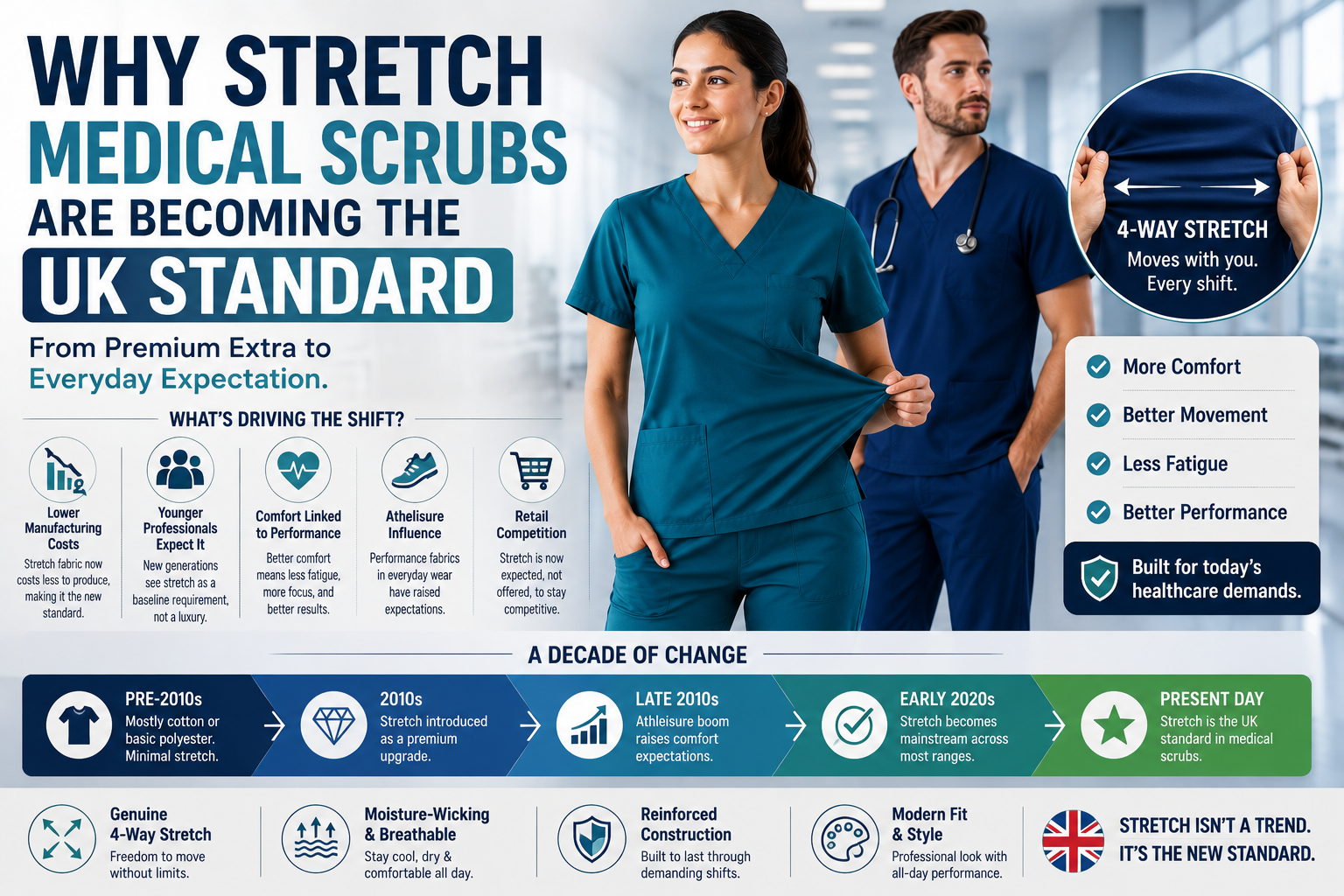
Manufacturing Costs Have Decreased
Elastane and spandex fibre production has become significantly more cost-effective over the past decade, narrowing the price gap between stretch and non-stretch fabric. What once required a substantial premium now adds comparatively little to overall production cost, making it commercially viable for manufacturers to include stretch as standard rather than reserving it for premium tiers.
Younger Healthcare Professionals Expect It
As workforce demographics shift, newer generations of healthcare professionals have grown up wearing performance and athletic-inspired clothing in daily life, where stretch fabric has long been standard rather than premium. This has shifted general expectations around workwear comfort, with many newer professionals treating four-way stretch as a baseline requirement rather than a luxury feature, putting pressure on scrub manufacturers and retailers to meet that expectation.
Growing Recognition of Comfort's Link to Performance
Awareness has grown across healthcare organisations and individual professionals alike regarding how uniform comfort affects fatigue, focus, and overall performance during long shifts. This shift in understanding covered in more detail in our article on why comfortable scrubs improve performance has increased demand for genuinely functional workwear rather than uniforms chosen purely on cost or basic appearance.
Athleisure and Performance Fabric Crossover
The broader athleisure trend across fashion and everyday clothing has influenced expectations in adjacent categories, including medical workwear. As stretch, moisture-wicking, and performance fabric became standard in gym wear, running gear, and even casual clothing, similar expectations have carried over into how healthcare professionals view their daily uniform.
Competitive Pressure Among Scrub Retailers
As more scrub brands began offering stretch fabric, retailers who continued offering only basic, non-stretch options found themselves at a competitive disadvantage. This created a broader market shift where stretch fabric became necessary simply to remain competitive, rather than a differentiating premium feature.
How This Shift Has Changed Buying Expectations
Stretch Is Now Often Assumed Rather Than Asked About
Where healthcare professionals once actively sought out and paid extra for stretch fabric, many now simply expect it as a baseline feature, sometimes without specifically checking for it, since it's become common enough to assume by default in many modern scrub ranges.
Non-Stretch Scrubs Are Increasingly Positioned as Budget Options
Rather than stretch being the premium tier, the market has effectively inverted non-stretch, purely cotton or basic polyester scrubs are now more commonly positioned and priced as the budget or entry-level option, while stretch blends occupy the mainstream, expected middle ground.
Quality Differentiation Has Shifted to Other Features
As stretch fabric became standard, the features that now differentiate premium from budget scrubs have shifted toward other areas reinforced stitching, moisture-wicking performance, fade resistance, and overall construction quality, discussed in more detail in our guide to 10 features every premium scrub should have.
A Rough Timeline of the Shift
Looking at how this transition has generally unfolded helps put the current moment in context.
Pre-2010s Medical scrubs were largely cotton or basic polyester, with minimal stretch. Fit was often boxy and unisex, with comfort features rarely marketed as a distinct selling point.
Early-to-mid 2010s Stretch fabric began appearing in premium scrub ranges, often marketed explicitly as an upgrade feature and priced accordingly above standard offerings.
Late 2010s Athleisure trends in broader fashion accelerated consumer expectations around comfort and stretch in everyday clothing, gradually influencing workwear categories including medical scrubs.
Early 2020s onward Stretch fabric became increasingly common across mainstream scrub ranges, with many retailers shifting it from a separate premium tier into their core, standard offering.
Present day Stretch fabric is widely treated as a baseline expectation across most mainstream UK scrub brands, with differentiation shifting toward complementary features like moisture-wicking, sustainability, and construction quality.
This timeline isn't precise or universally consistent across every brand and market segment, but it reflects the general direction the industry has moved over roughly the past decade and a half.
Is Stretch Fabric Actually Necessary for Every Role?
While the industry-wide shift is real, it's worth noting that not every healthcare role experiences the same practical benefit from stretch fabric. Highly active roles nursing, emergency care, physiotherapy see the clearest functional advantage, while lower-mobility roles may notice more of a comfort preference than a strict practical necessity.
That said, as stretch fabric has become standard across most mainstream scrub ranges regardless of role-specific marketing, many professionals in lower-mobility roles now wear stretch scrubs simply because non-stretch alternatives have become harder to find in mainstream ranges, rather than through an active, role-specific decision.
What This Means for UK Healthcare Purchasing Decisions
For Individual Professionals
Given how widespread stretch fabric has become, checking fabric composition remains worthwhile, but the practical decision has shifted somewhat from "should I pay extra for stretch" to "which specific stretch blend and construction quality suits my role best," since stretch fabric alone no longer reliably signals premium quality the way it once did.
For Trusts and Bulk Procurement
Organisations purchasing scrubs at scale, including NHS trusts and larger private healthcare groups, increasingly factor stretch fabric into baseline procurement standards rather than treating it as an optional upgrade, reflecting the same shift seen at the individual buying level.
For Scrub Manufacturers and Retailers
The competitive landscape has shifted meaningfully retailers differentiate less on whether stretch fabric is offered at all, and more on the quality, durability, and specific performance characteristics of their particular stretch blend, along with complementary features like moisture-wicking and reinforced construction.
Will This Trend Continue?
Based on the broader trajectory of workwear and performance fabric more generally, it seems likely that stretch fabric will continue solidifying as a genuine baseline expectation across UK medical scrubs, similar to how features like moisture-wicking and wrinkle resistance have followed a comparable path from premium to standard over recent years. The next area of differentiation is likely to continue shifting toward sustainability credentials, advanced odour resistance, and construction quality, following the same pattern that made stretch fabric standard in the first place.
Why ScrubNext Includes Genuine Stretch Fabric as Standard
At ScrubNext, we've built four-way stretch performance fabric into our core range from the start, reflecting this broader industry shift rather than treating it as a separate premium tier:
-
Genuine four-way stretch across our full scrub range
-
Combined with moisture-wicking and breathable properties, not stretch alone
-
Reinforced construction that complements the comfort stretch fabric provides
-
Consistent quality across colours and styles, rather than reserving stretch for select premium lines
Frequently Asked Questions
Why has stretch fabric become standard in medical scrubs?
A combination of decreased manufacturing costs, changing workforce expectations, growing awareness of comfort's link to performance, and competitive pressure among retailers has driven stretch fabric from a premium feature to a widespread baseline expectation.
Do all UK scrub brands now include stretch fabric?
Not universally, but it has become common enough across mainstream ranges that non-stretch options are increasingly positioned as budget or entry-level alternatives rather than the standard choice.
Is stretch fabric necessary for lower-mobility healthcare roles?
It offers less of a strict functional necessity for lower-mobility roles compared to highly active ones, though many professionals in these roles still prefer it for general comfort, and it has become harder to avoid as mainstream ranges shift toward stretch as default.
Does stretch fabric still indicate premium quality?
Less reliably than in the past. Since stretch has become widespread, other features like reinforced stitching, moisture-wicking performance, and fade resistance have become more meaningful indicators of genuine premium quality.
Will non-stretch scrubs disappear entirely?
Unlikely in the near term, though they're increasingly positioned as a budget category rather than a mainstream default, following the broader trajectory seen across performance workwear generally.
Final Thoughts
Stretch fabric's shift from premium feature to industry standard reflects broader changes in manufacturing, workforce expectations, and a growing understanding of how uniform comfort affects performance during demanding healthcare shifts. Understanding this trend helps explain why stretch is now often assumed by default and why genuine quality differentiation has shifted toward other features worth checking for when comparing scrub options today.
Explore ScrubNext's stretch performance scrub range and experience the comfort that's become the UK healthcare standard.