Why Moisture-Wicking Scrubs Are Worth It
2026-08-17 12:16:26
Introduction
"Moisture-wicking" has become a standard term on scrub product pages, but it's often used loosely, sometimes interchangeably with "breathable," even though the two describe genuinely different fabric properties. Understanding exactly how moisture-wicking technology works and what separates a fabric that genuinely wicks moisture from one that simply feels lightweight makes it much easier to judge whether a scrub is actually worth the claim.
This article looks specifically at the mechanism behind moisture-wicking fabric, how it differs from breathability, and why it matters more for some healthcare roles than others.
Moisture-Wicking vs Breathable: What's the Actual Difference?
These terms are frequently used together, but they describe different things.
Breathability refers to how easily air passes through a fabric. A breathable fabric allows heat to escape and air to circulate, which helps regulate temperature. Cotton, for example, is highly breathable due to its natural fibre structure.
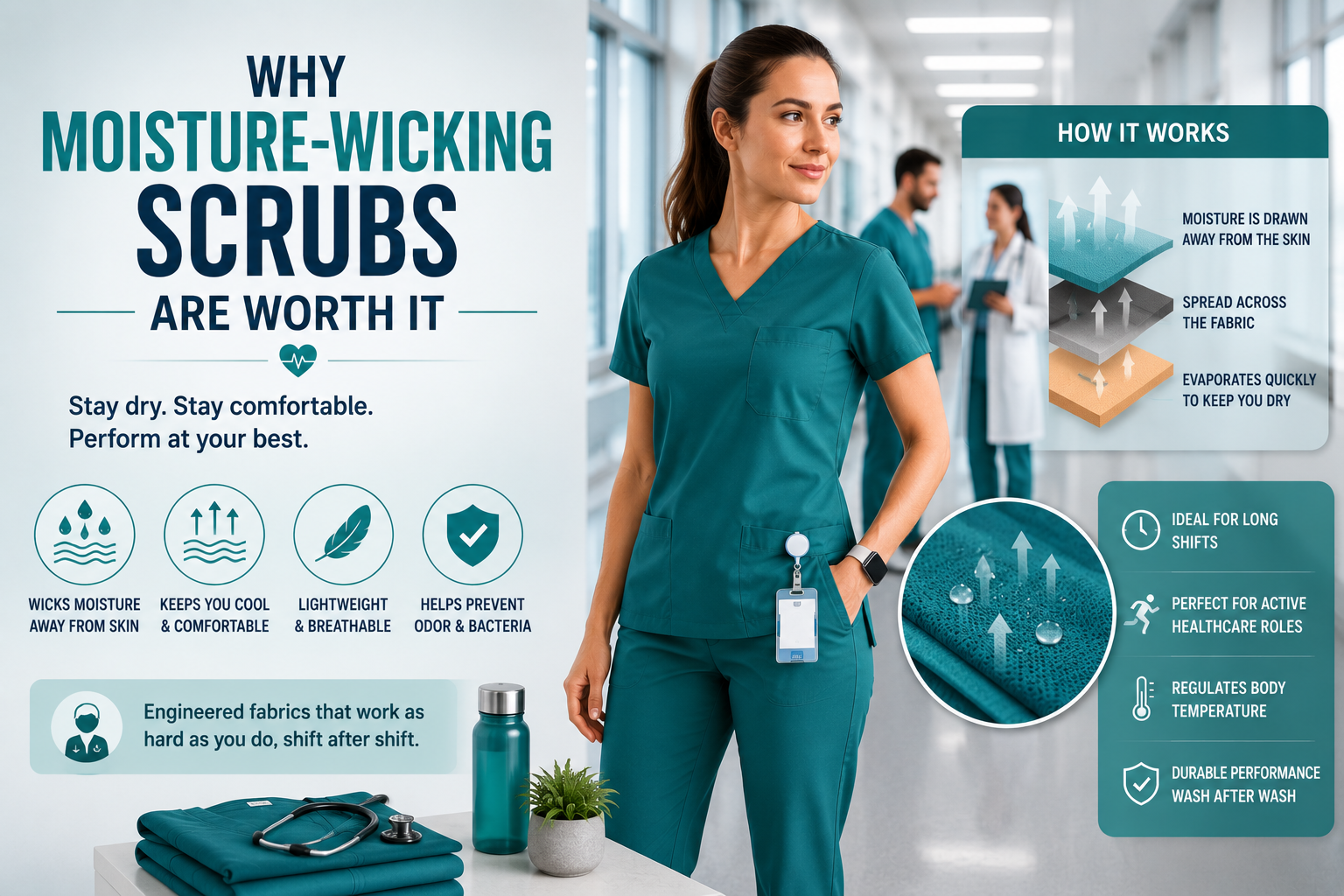
Moisture-wicking refers to a fabric's ability to actively pull liquid (sweat) away from the skin and move it to the fabric's outer surface, where it can evaporate more quickly. This is a mechanical and often chemical property of the fibre itself, not simply a matter of how loosely the fabric is woven.
A fabric can be breathable without being particularly moisture-wicking, and vice versa. Cotton is a useful example it's breathable and absorbs moisture well, but it doesn't actively move that moisture away from the skin. Instead, cotton tends to hold onto moisture, which is why a cotton scrub can start to feel damp and heavy during a long, active shift, even though the fabric itself is breathable.
How Moisture-Wicking Fabric Actually Works
Moisture-wicking fabric typically relies on one of two mechanisms, sometimes both combined.
Capillary Action
Many moisture-wicking synthetic fibres, such as polyester, are engineered with a specific fibre structure often featuring tiny grooves or channels along the fibre's surface. These channels use capillary action to draw moisture away from the skin and spread it across a wider surface area of the fabric, where it can evaporate faster than it would if concentrated in one area.
Hydrophobic and Hydrophilic Fibre Combinations
Some performance fabrics combine a hydrophobic (moisture-repelling) inner layer, positioned against the skin, with a hydrophilic (moisture-attracting) outer layer. This combination actively pushes moisture away from the body toward the outer surface, rather than allowing it to sit against the skin, functioning almost like a one-way valve for sweat.
Fabric Treatments and Finishes
In addition to fibre structure, some fabrics are treated with a moisture-wicking finish during manufacturing, which enhances the fabric's natural ability to move moisture. These treatments can wear down over time with repeated washing, which is part of why fabric quality and correct care both affect how well moisture-wicking performance holds up over a scrub's lifespan.
Why This Matters Specifically for Healthcare Shifts
Healthcare professionals sweat under conditions that differ meaningfully from general daily activity long shifts, physically demanding tasks, warm clinical environments, and often additional PPE layers that trap heat and moisture against the body far more than everyday clothing would.
Under PPE, moisture has nowhere to go. Without genuine moisture-wicking fabric, sweat accumulates against the skin, which can lead to discomfort, chafing, and a general sense of overheating well before a shift ends.
Extended shifts give moisture more time to build up. A fabric that manages moisture adequately over a 4-hour period may perform noticeably worse over 10-12 hours, simply because there's more total sweat for the fabric to move and evaporate.
Fast-paced, physically active roles generate more sweat overall. Nurses, emergency staff, and physiotherapists moving constantly throughout a shift benefit more from genuine moisture-wicking fabric than roles involving less physical activity.
This is part of why moisture-wicking claims matter more in medical scrubs specifically than in general workwear the conditions genuinely test the fabric's actual performance rather than just its marketing description.
How to Tell If a Scrub Is Genuinely Moisture-Wicking
Given how loosely the term gets used, a few practical checks help separate genuine moisture-wicking fabric from a general "breathable" or "lightweight" claim.
Check the fabric composition, not just the marketing description Synthetic fibres like polyester are far more likely to have genuine moisture-wicking properties than pure cotton, regardless of how a product is described.
Look for specific technical language Terms like "capillary action," "moisture transport," or references to a specific fabric technology (rather than just "cool" or "breathable") often indicate a more genuine, engineered moisture-wicking property.
Read reviews mentioning sweat or heat specifically Customer feedback that directly addresses how a fabric performs during physically active or long shifts tends to be more reliable than the general product description alone.
Consider the fibre blend Performance fabrics combining polyester with a small percentage of spandex or elastane often perform well for moisture-wicking, since the synthetic base supports the wicking mechanism while the stretch fibre adds flexibility.
Common Myths About Moisture-Wicking Fabric
"Moisture-wicking fabric doesn't get sweaty at all." Not true moisture-wicking fabric doesn't prevent sweating, it manages moisture more effectively once sweat occurs, moving it away from the skin and helping it evaporate faster than it would in non-wicking fabric.
"All polyester scrubs are automatically moisture-wicking." Not necessarily. While polyester is a common base for moisture-wicking fabric, the specific fibre structure and any additional finishing treatments determine how well a particular polyester scrub actually performs, so not every polyester scrub is engineered the same way.
"Cotton scrubs can't be moisture-wicking at all." Pure cotton generally isn't strongly moisture-wicking, but cotton blended with synthetic fibres can gain some moisture-wicking properties from the synthetic component, though typically less than a fully synthetic performance fabric.
Does Moisture-Wicking Fabric Wear Out Over Time?
Yes, to some degree. Moisture-wicking performance can diminish slightly over the lifespan of a garment, particularly if fabric finishes (rather than the fibre structure itself) are responsible for the effect, and especially with frequent high-heat washing or drying. This is one of several reasons correct fabric care matters following the specific care label and avoiding excessive heat helps preserve moisture-wicking performance for longer, alongside the fabric's colour and stretch.
The Connection Between Moisture-Wicking and Odour Control
Moisture-wicking fabric has a secondary benefit that's often overlooked: reduced odour build-up. Bacteria responsible for sweat odour thrive in damp conditions, so fabric that moves moisture away from the skin and helps it evaporate faster gives bacteria less opportunity to develop compared to fabric that holds moisture against the body for extended periods.
This is part of why moisture-wicking and odour-resistant treatments are frequently found together in performance scrub fabric they address related but distinct problems. Moisture-wicking manages where sweat goes, while odour-resistant treatments (sometimes silver-ion or antimicrobial finishes) target the bacteria directly. Together, they tend to produce noticeably fresher-feeling scrubs across a long shift than either property alone would achieve.
For healthcare professionals working back-to-back long shifts with limited time between washes, this combination can matter as much as temperature regulation, particularly by the later hours of a demanding day.
Who Benefits Most from Moisture-Wicking Scrubs?
While most healthcare professionals notice some benefit, a few groups tend to notice the biggest difference:
-
Nurses and ward staff on their feet for extended, physically active shifts
-
Emergency and A&E staff working in fast-paced, high-intensity conditions
-
Theatre and surgical staff wearing scrubs under additional PPE layers for extended periods
-
Anyone working 12-hour shifts, where moisture has significantly more time to accumulate compared to shorter working days
-
Professionals working in warmer clinical environments, where standard breathable fabric alone may not be sufficient
Roles with lower physical activity or shorter shifts may notice less dramatic benefit, though moisture-wicking fabric rarely has meaningful downsides even in lower-demand roles.
Why ScrubNext Uses Genuine Moisture-Wicking Fabric
At ScrubNext, our performance fabric is engineered specifically for moisture management, not just marketed with the term:
-
Synthetic fibre blends designed with genuine capillary moisture transport
-
Combined with breathable construction for full temperature regulation, not just moisture control alone
-
Durable finishing that maintains wicking performance through repeated washing
-
Paired with four-way stretch, so moisture management doesn't come at the cost of mobility
Frequently Asked Questions
Is moisture-wicking fabric the same as breathable fabric?
No. Breathability refers to airflow through the fabric, while moisture-wicking refers to actively moving sweat away from the skin. A fabric can have one property without the other, though many performance fabrics combine both.
Does cotton have moisture-wicking properties?
Pure cotton generally doesn't wick moisture effectively, though it does absorb it, which can lead to a damp, heavy feeling during long or active shifts. Cotton blended with synthetic fibres can gain some moisture-wicking benefit from the synthetic component.
Do moisture-wicking scrubs actually reduce sweating?
No, moisture-wicking fabric doesn't reduce how much you sweat it manages the moisture more effectively once sweating occurs, helping it evaporate faster and keeping it away from direct skin contact.
Does moisture-wicking performance fade over time?
Yes, to some degree, particularly with frequent high-heat washing or drying. Following correct care instructions helps preserve moisture-wicking performance for longer.
Is moisture-wicking fabric worth it for shorter, less active shifts?
It can still help, though the difference tends to be less noticeable compared to long, physically demanding shifts where moisture has more time to accumulate.
Final Thoughts
Moisture-wicking fabric is a genuine, engineered property not just a marketing term that actively moves sweat away from the skin rather than simply allowing air to circulate. For healthcare professionals working long, physically demanding shifts, particularly under PPE, this distinction can make a real difference to comfort by the later hours of a shift.
Understanding the mechanism behind moisture-wicking fabric makes it easier to judge genuine performance claims from vague marketing language, and to choose scrubs that actually deliver on what the label promises.
Explore ScrubNext's moisture-wicking performance scrubs and feel the difference through your next long shift.