NHS Scrubs Explained: Colours, Standards & Uniform Guide
2026-08-11 10:14:23
Introduction
If you're new to the NHS, changing departments, or simply trying to understand why colleagues on your ward wear different coloured scrubs, it can be genuinely confusing. Unlike some countries with a single national scrub colour standard, the NHS doesn't operate one uniform dress code across every trust. Instead, individual NHS trusts set their own uniform policies, which means scrub colours, styles, and rules can vary noticeably depending on where you work.
This guide explains how NHS uniform policy generally works, what scrub colours tend to mean across different trusts, the hygiene standards behind uniform rules, and what to check before buying scrubs for an NHS role.
Does the NHS Have a National Scrub Colour Policy?
No single national colour code applies across every NHS trust in the UK. Uniform policy is typically set at the trust level, meaning two hospitals in neighbouring towns can have completely different colour systems for the same role. This is one of the most common points of confusion for newly qualified nurses, agency staff moving between trusts, or students on rotational placements.
What does exist at a national level is broader guidance around hygiene, infection control, and general uniform standards covering things like sleeve length, jewellery, and laundering practices rather than a fixed colour scheme. Because of this, the single most reliable step before buying scrubs for an NHS role is always to check your specific trust's uniform policy directly, rather than assuming a colour based on general convention.
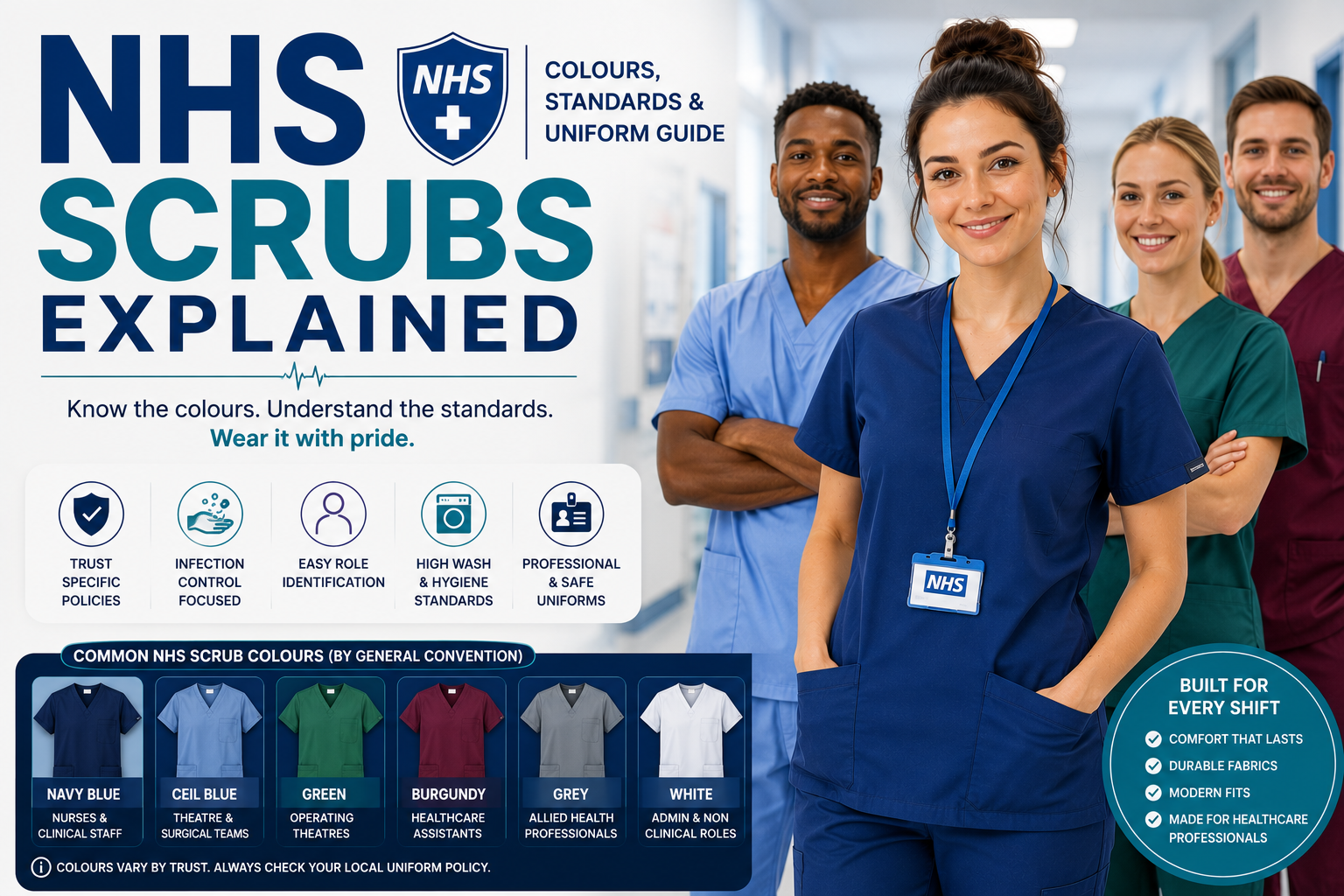
Commonly Used NHS Scrub Colours (By General Convention)
While policies vary by trust, certain colour associations have become common across much of the NHS and wider UK healthcare system. These aren't universal rules, but they reflect frequently used patterns worth understanding.
|
Colour |
Commonly Associated With* |
|
Navy Blue |
Registered nurses, general clinical staff |
|
Ceil Blue |
Surgical teams, theatre staff |
|
Green |
Operating theatres |
|
Burgundy |
Healthcare assistants, specialist clinics |
|
Grey |
Physiotherapy, pharmacy, allied health professionals |
|
White |
Some administrative or non clinical roles |
|
Black |
Less common in NHS settings; more frequent in private healthcare |
*These associations vary by trust and department. Always confirm your specific employer's uniform policy before purchasing scrubs.
Some trusts also use colour to distinguish seniority or role level for example, a different shade or accent colour for ward sisters, healthcare assistants, or student nurses. This system, sometimes referred to informally as a "colour coded" uniform policy, helps patients and staff quickly identify roles at a glance, particularly in larger hospitals with many different types of staff on a single ward.
Why NHS Uniform Standards Exist
NHS uniform policies aren't just about appearance they're primarily built around infection control, professionalism, and practical safety considerations.
Infection control Guidance commonly includes rules such as bare below the elbows during clinical contact, discouraging the wearing of ties, and setting laundering frequency expectations, all aimed at reducing the risk of cross contamination between patients.
Professional identification Consistent uniform colours within a trust help patients, families, and colleagues quickly identify a staff member's role, which becomes especially important during busy or emergency situations.
Practical safety Uniform standards often address details like sleeve length around equipment, appropriate footwear, and secure ID badge display, all of which support both hygiene and day to day safety on a ward.
Consistency and trust A recognisable, professional uniform helps reinforce patient confidence, particularly during initial contact when a patient may not yet know a staff member's specific role.
What NHS Uniform Guidance Commonly Covers
While specific policies differ between trusts, most NHS uniform guidance addresses a similar set of core areas:
-
Sleeve length Often requiring bare below the elbows during direct clinical care, to support effective hand hygiene
-
Jewellery Frequently restricted to a plain wedding band, with rings, bracelets, and wrist watches often discouraged during clinical duties
-
Footwear Usually required to be closed toe, low heeled, and non slip for safety
-
ID badges Typically required to be worn visibly at all times while on duty
-
Nail policy Often restricting false nails or nail polish, particularly in clinical or surgical roles, due to infection control concerns
-
Laundering Frequently recommending or requiring scrubs to be washed at a specific minimum temperature, either at home or through hospital laundry services, depending on the trust
Because these details vary between trusts, it's always worth reviewing your specific employer's uniform policy document, usually available through HR or occupational health, rather than relying on general assumptions.
What to Look for When Buying Scrubs for NHS Roles
Regardless of which specific colour or style your trust requires, certain features matter consistently for NHS work, given the demands of long shifts and frequent industrial washing.
Durability for Frequent Washing
NHS scrubs are typically washed after every shift, sometimes at high temperatures depending on trust laundering requirements. Look for fabric that resists shrinking, fading, and losing shape under these conditions polyester blends and performance fabrics tend to perform best here.
Comfort for Long Shifts
Many NHS roles involve 12 hour shifts with significant physical activity. Breathable, moisture wicking fabric with four way stretch helps maintain comfort throughout a demanding day, particularly for nursing, emergency care, and physiotherapy roles.
Compliance with Sleeve and Fit Requirements
Since many NHS trusts require bare below the elbows during clinical contact, short sleeved scrub tops are the standard choice. Checking sleeve length and overall fit against your trust's specific policy avoids the need to return or exchange an order after purchase.
Correct Colour Before Ordering
Given how much colour policy varies by trust and department, it's worth double checking with your ward manager, HR department, or occupational health team before ordering scrubs in a specific colour, rather than assuming a colour based on general convention or a previous role at a different trust.
NHS Scrubs vs Private Healthcare Scrubs: Key Differences
While the core features that make a good scrub comfort, durability, practical pockets apply across both NHS and private healthcare settings, there are a few practical differences worth knowing.
Colour policy strictness NHS trusts often enforce colour policy more strictly and consistently across departments, while some private clinics allow more flexibility or use colour primarily for branding purposes.
Laundering expectations NHS trusts frequently specify minimum washing temperatures or provide on site laundering services, while private practices may leave laundering entirely to individual staff discretion.
Uniform allowances Some NHS trusts provide uniform allowances or specific supplier arrangements, while private healthcare settings vary more widely in how uniforms are sourced and funded.
Style flexibility Private clinics, particularly smaller or specialist practices, sometimes allow more flexibility in scrub style (such as jogger style trousers) compared to larger NHS trusts with more standardised policies.
How to Confirm Your Trust's Specific Uniform Policy
Since colour and style requirements are set locally rather than nationally, the most reliable way to get accurate information is to go directly to the source rather than relying on general guidance like this article.
-
Check your trust's intranet or HR portal most trusts publish a formal uniform policy document, often under HR or occupational health resources
-
Ask your ward manager or department lead particularly useful when starting a new role or rotating to a different department within the same trust
-
Contact occupational health especially relevant for questions about jewellery, nail policy, or any health related uniform exceptions
-
Check with agency staffing coordinators if you work as an agency or bank nurse across multiple trusts, confirm the specific policy for each placement individually, since assumptions carried over from a previous trust can lead to an incorrect uniform on day one
Taking this step before ordering scrubs avoids the inconvenience of returns or last minute replacements, particularly for time sensitive situations like starting a new role or placement.
Common Questions About NHS Uniform Policy
Can I choose any brand of scrubs as an NHS employee?
This depends on your trust. Some NHS trusts supply uniforms directly or require ordering through an approved supplier, while others allow staff to purchase their own scrubs as long as they meet the trust's colour and style requirements. Always check with HR or your department before buying independently.
Do all NHS nurses wear the same colour?
No. While navy blue is common for registered nurses across many trusts, this isn't universal, and some trusts use entirely different colour systems. Colour should always be confirmed against your specific trust's policy rather than assumed from general convention.
Can I wear jogger style scrub trousers in an NHS role?
This varies by trust. Many NHS trusts have updated their uniform policies in recent years to permit more modern scrub styles, including jogger style trousers, but it's still worth confirming with your department before purchasing, since some trusts maintain more traditional style requirements.
How often do NHS staff need to wash their scrubs?
Guidance commonly recommends washing scrubs after every shift, often at a specified minimum temperature to support infection control. Specific requirements can vary by trust, so checking your local policy is the most reliable approach.
Why ScrubNext Works for NHS and Private Healthcare Staff
ScrubNext scrubs are designed to meet the practical demands of both NHS and private healthcare roles, with features that support compliance and comfort across a wide range of workplace policies:
-
Short sleeved styles suited to bare below the elbow requirements
-
Durable, fade resistant fabric built to withstand frequent, high temperature washing
-
Four way stretch performance fabric for long, physically demanding shifts
-
A wide colour range, including the most commonly required NHS shades
-
Practical, secure pockets for ID badges and clinical tools
-
Consistent sizing across our full range, reducing the risk of ordering errors
Whatever your trust's specific uniform policy requires, ScrubNext offers scrubs built to perform reliably through demanding NHS and private healthcare shifts alike.
Frequently Asked Questions
Does the NHS have one official scrub colour for all nurses?
No. The NHS does not operate a single national scrub colour policy. Uniform and scrub colour requirements are typically set at the individual NHS Trust level, so they can vary across the UK.
What colour scrubs do most NHS nurses wear?
Navy blue is commonly associated with registered nurses across many NHS Trusts, but this is not universal. Always check your specific Trust's uniform policy before ordering scrubs.
Are there NHS rules about scrub sleeve length?
Many NHS Trusts require staff to follow a bare-below-the-elbows approach during clinical contact as part of infection control guidance. This generally makes short-sleeved scrub tops the standard choice for clinical duties.
Can I buy my own scrubs for an NHS job, or does the Trust provide them?
This depends on the individual NHS Trust. Some Trusts provide uniforms directly or specify an approved supplier, while others allow staff to purchase their own scrubs provided they meet the required colour, style and uniform standards. Check with HR or your department before purchasing.
Do NHS uniform rules cover jewellery and nail polish?
Many NHS Trusts restrict jewellery to a plain wedding band and discourage false nails or nail polish during clinical duties, primarily for infection control reasons. However, specific requirements can vary between Trusts, so always check your local uniform and infection control policy.
Final Thoughts
NHS scrub colours and uniform standards vary more than many people expect, since policy is set at the trust level rather than nationally. Understanding the general principles behind these policies infection control, professional identification, and practical safety helps explain why colour and style requirements differ so much between hospitals.
Before ordering scrubs for an NHS role, the most reliable step is always checking your specific trust's uniform policy directly. Once you know exactly what's required, choosing scrubs built for comfort, durability, and frequent washing makes the rest of the decision straightforward.
Browse ScrubNext's full scrub colour range and find NHS ready scrubs built for long, demanding shifts.